Why do returns and refunds become a support problem before they become a finance problem?
Returns and refunds become a support problem first because the customer usually wants a clear answer before the internal process is complete. A shopper may ask where the courier is, whether an exchange was approved, when the refund will be released, why a product was rejected, or who owns the next step. If nobody owns the conversation, the operational delay quickly becomes a customer experience issue.
For GCC e-commerce brands, the risk is not only one unhappy customer. The larger risk is that returns conversations start consuming the same team that should be handling new sales questions, order updates, and campaign demand. When founders, operations managers, or customer experience leads are personally checking refund cases, the process has outgrown informal handling.
Returns and refunds support outsourcing is most useful when the brand needs better case ownership, cleaner follow-up, and more consistent communication without immediately building a larger in-house department.
When should a GCC e-commerce brand consider outsourcing returns and refunds support?
A GCC e-commerce brand should consider outsourcing returns and refunds support when case follow-up is taking attention away from growth, warehouse coordination, supplier work, or customer acquisition. The signal is not just high ticket volume. The stronger signal is repeated confusion: customers ask the same question twice, agents give different answers, refunds wait for manual checking, and managers step in to rescue delayed cases.
This type of outsourcing is especially relevant when returns are handled across several moving parts: WhatsApp or live chat for the customer, a courier or last-mile partner for pickup, a warehouse or fulfillment team for inspection, a finance owner for refund release, and a store platform or CRM for status updates. If the workflow lives in people’s memory instead of a clear process, service quality becomes fragile.
- Customers are chasing exchange or refund status through multiple channels.
- Support agents cannot see enough order context to answer confidently.
- Operations teams are spending too much time responding to simple customer follow-up.
- Refund approvals are separate from customer communication, causing silence between steps.
- Peak campaigns create return spikes that the internal team cannot absorb cleanly.
What work can be outsourced without losing control of refunds?
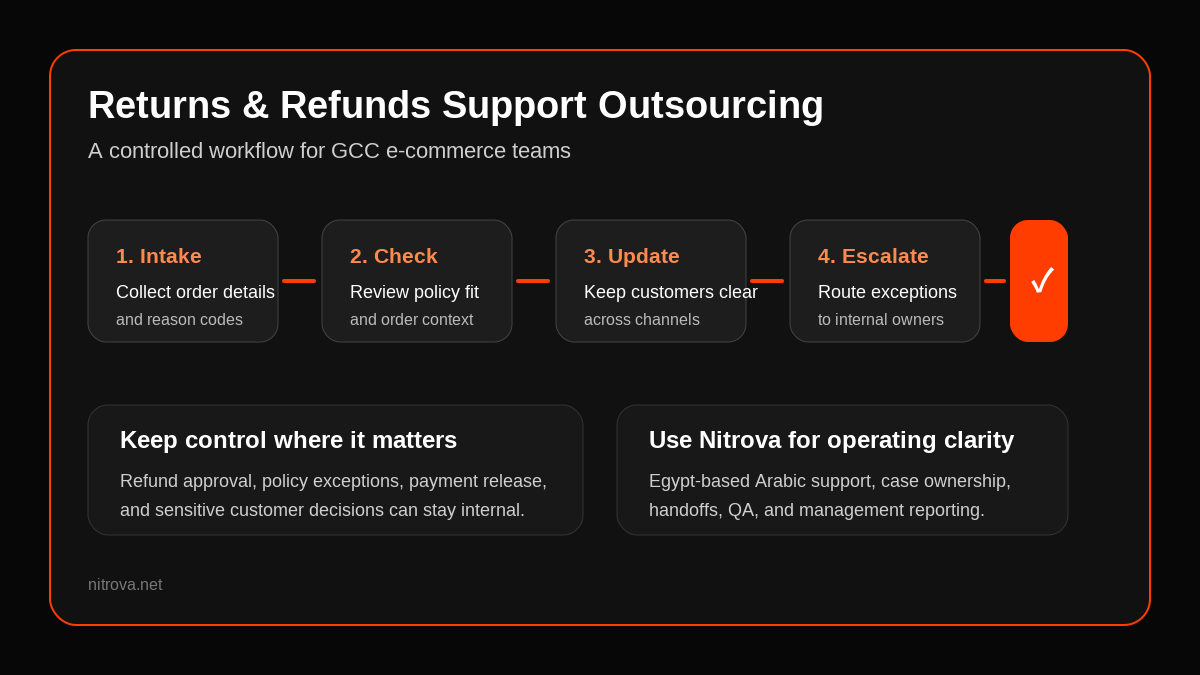
A brand can outsource a large part of returns support without handing over full financial authority. The outsourced team can manage customer communication, collect required details, update CRM or helpdesk records, prepare cases for approval, follow the return policy, coordinate with the relevant internal owner, and escalate exceptions. Final refund approval, payment release, policy changes, and high-risk exceptions can remain with the brand.
That distinction matters. Good outsourcing does not mean giving an external team unlimited access or decision rights. It means designing the workflow so that routine cases move faster while sensitive decisions remain controlled. For example, an agent can confirm that a request meets documented policy, gather order evidence, tag the reason code, and route the case to finance or operations for the final action.
| Workstream | Can be outsourced? | Control point to define |
|---|---|---|
| Customer status updates | Usually yes | Approved tone, templates, and escalation wording |
| Return request intake | Usually yes | Required fields, evidence, and eligibility checks |
| Courier or warehouse follow-up | Often yes | Which systems the team may access and what they may change |
| Refund approval | Usually retained internally | Named approver, approval threshold, and exception path |
| Policy exceptions | Escalated | Who can override the standard policy |
How should returns support connect with WhatsApp, live chat, and order management?
Returns support should connect with the channels customers already use, not sit in a disconnected inbox. In many GCC e-commerce operations, customers ask about returns through WhatsApp, live chat, Instagram messages, phone calls, and email. If the outsourced team handles only one channel without visibility into order context, customers may still receive fragmented answers.
A stronger setup maps the journey from first return request to final closure. The team needs to know what information to collect, where to record it, how to check order status, when to involve operations, and how to close the loop after refund or exchange confirmation. This is where customer support outsourcing and virtual assistance often overlap: the customer conversation and the back-office follow-up have to work together.
Dedicated or shared agents: which model fits returns and refunds?
Dedicated agents usually fit brands with steady return volume, complex product rules, frequent exceptions, or a strong brand tone requirement. Shared support can fit brands with lighter volume, predictable policies, or seasonal need, provided the workflow is simple enough to document and monitor.
The decision should not be based only on current ticket count. A small but complex returns queue may need dedicated ownership because each case requires order checking, warehouse context, customer judgment, and careful escalation. A larger but highly standardized queue may work with a shared model if the rules are clear and the brand is comfortable with defined coverage windows.
| Question | Dedicated model | Shared model |
|---|---|---|
| Product complexity | Better for many SKUs, warranties, or exceptions | Better for simple policies and repeatable answers |
| Brand tone | Stronger consistency and deeper training | Works when scripts and escalation rules are enough |
| Coverage | Useful for predictable daily workload | Useful for limited or overflow coverage |
| Management need | More room for reporting and process ownership | Lower setup burden when the workflow is narrow |
What access boundaries should be agreed before outsourcing?
Access boundaries should be agreed before the first customer case is handled. Returns and refunds touch customer data, order history, addresses, payment references, courier records, warehouse notes, and sometimes complaint details. A provider should not receive broad access by default. The brand should decide exactly which systems are needed for the task and which actions require internal approval.
Practical boundaries include role-based CRM or helpdesk access, limited order-management permissions, separate approval rights for refunds, documented escalation paths, password and account ownership rules, and a clear policy for exporting or storing customer data. This is operational discipline, not bureaucracy. It protects the brand and helps agents work faster because they know what they can and cannot do.
What should quality assurance measure in returns support?
Quality assurance should measure whether the customer received a clear, accurate, and timely answer at each stage of the return or refund journey. Speed matters, but speed alone is not enough. An agent can reply quickly and still create risk if the answer conflicts with policy, promises something operations cannot complete, or fails to record the next step.
- Policy accuracy: did the answer match the documented return or refund rules?
- Case ownership: did the agent record the next action and responsible owner?
- Customer clarity: did the customer understand what will happen next?
- Escalation quality: were exceptions routed to the right internal person?
- Closure discipline: was the customer updated after the case moved or closed?
- Root-cause tagging: were reasons captured in a way management can review?
These measures help the buyer assess more than agent friendliness. They show whether the outsourced support team is reducing operational noise or simply moving messages from one inbox to another.
How should cost be evaluated without relying on fake savings claims?
Cost should be evaluated through the full operating burden, not a headline salary comparison. In-house handling includes recruitment time, training, supervision, replacement hiring, quality assurance, tools, scheduling, performance management, and the opportunity cost of senior employees managing routine cases. Outsourcing may reduce some of that burden, but it still requires onboarding, process design, access setup, reporting, and internal escalation ownership.
The right question is not “Which option is cheapest?” The better question is “Which model gives us reliable case ownership at the right management load?” A founder or COO should compare the current hidden cost of delays, repeated customer follow-up, manual checking, and manager involvement against the structure a provider can bring.
Why can Egypt be a practical delivery base for GCC returns support?
Egypt can be a practical base when the work depends on Arabic communication, customer empathy, operational follow-up, and schedule alignment with Gulf business hours. The advantage is not a magic shortcut. It is the ability to build support capacity with Arabic-speaking talent, GCC-aware tone, and operational flexibility without asking the brand to recruit and manage every role internally.
For returns and refunds specifically, that matters because agents need to handle frustrated customers calmly while also following process. They need to explain policy without sounding cold, collect details without making the customer repeat themselves, and know when to escalate instead of improvising. Those are training and management issues, not just language issues.
How can Nitrova fit this workflow?
Nitrova is relevant when a GCC e-commerce company wants Egypt-based support capacity that can plug into customer support and operational follow-up. The practical conversation should start with the brand’s existing channels, return policy, order-management flow, coverage needs, and escalation structure. From there, Nitrova can help the buyer think through whether returns support should be handled as a dedicated role, shared support layer, or part of a broader customer support team.
This is where Nitrova should be evaluated on operating clarity, not generic outsourcing language. A useful discovery call should cover who owns refund approval, which tools agents can access, what should be escalated, how quality will be reviewed, how peak periods will be staffed, and how reporting should show recurring return reasons. Buyers can also review Nitrova’s broader company background before deciding whether the delivery model fits their operating style.
What should you prepare before speaking with an outsourcing provider?
Before speaking with Nitrova or any provider, prepare the operational facts that shape the model. You do not need a perfect process before asking for help, but you do need enough detail to avoid a vague sales conversation.
- Monthly order volume and the approximate pattern of return or exchange requests.
- Current support channels: WhatsApp, live chat, phone, email, social, or marketplace messages.
- Return reasons that appear most often, described qualitatively if exact reporting is not available.
- Who currently approves refunds, exchanges, warranty decisions, and policy exceptions.
- Which CRM, helpdesk, store platform, courier portal, or order-management tool the team uses.
- Required coverage hours, weekend needs, campaign periods, and seasonal spikes.
- Brand tone rules, escalation language, and customer appeasement boundaries.
- Reports leadership wants to see: backlog, aging cases, reason tags, escalations, and closure status.
If returns are creating repeated customer follow-up, the issue is usually not solved by “answering faster” alone. It needs ownership, policy discipline, system visibility, and clear handoffs.
What is the safest way to start?
The safest way to start is with a clearly bounded workflow. Instead of handing over the entire returns operation at once, define the first scope: customer intake, status follow-up, case tagging, escalation preparation, or overflow coverage during campaigns. Then review quality, handoffs, and reporting before expanding the role.
For many GCC e-commerce teams, this pilot-style approach protects control while revealing where the process is actually breaking. It also helps the provider learn the brand’s tone, policy limits, and internal systems before taking on more sensitive work.
If your team is spending too much time chasing return cases, refund updates, or exchange follow-up, contact Nitrova with your team size, support channels, coverage hours, current return workflow, and the operating problems slowing you down. The first conversation should be about designing a support model that fits your process, not forcing your brand into a generic call-center package. You can reach Nitrova through the contact form or by email at info@nitrova.net.
FAQ
When should a GCC e-commerce brand outsource returns and refunds support?
Outsourcing becomes worth considering when returns, exchanges, refund follow-up, and delivery disputes are slowing internal teams, creating inconsistent customer answers, or distracting managers from growth and supplier operations.
Can returns support be outsourced without giving full finance access?
Yes. Many workflows can separate customer communication, case preparation, evidence collection, CRM updates, and escalation from final refund approval or payment release, which can stay with the brand.
Is Egypt a practical base for GCC returns and refunds support?
Egypt can be practical because teams can cover Arabic communication, work close to GCC business hours, understand regional customer tone, and scale operational support without forcing the brand to build a larger in-house support layer.
Should returns support sit under customer support or operations?
It should be jointly designed. Customer support owns the customer conversation, while operations should define policies, carrier handoffs, warehouse checks, refund approvals, and exception rules.
What should a brand prepare before speaking with Nitrova?
Useful preparation includes order volume, return reasons, current channels, refund approval rules, carrier or warehouse handoffs, CRM or helpdesk tools, coverage hours, escalation owners, and the pain points slowing the current workflow.