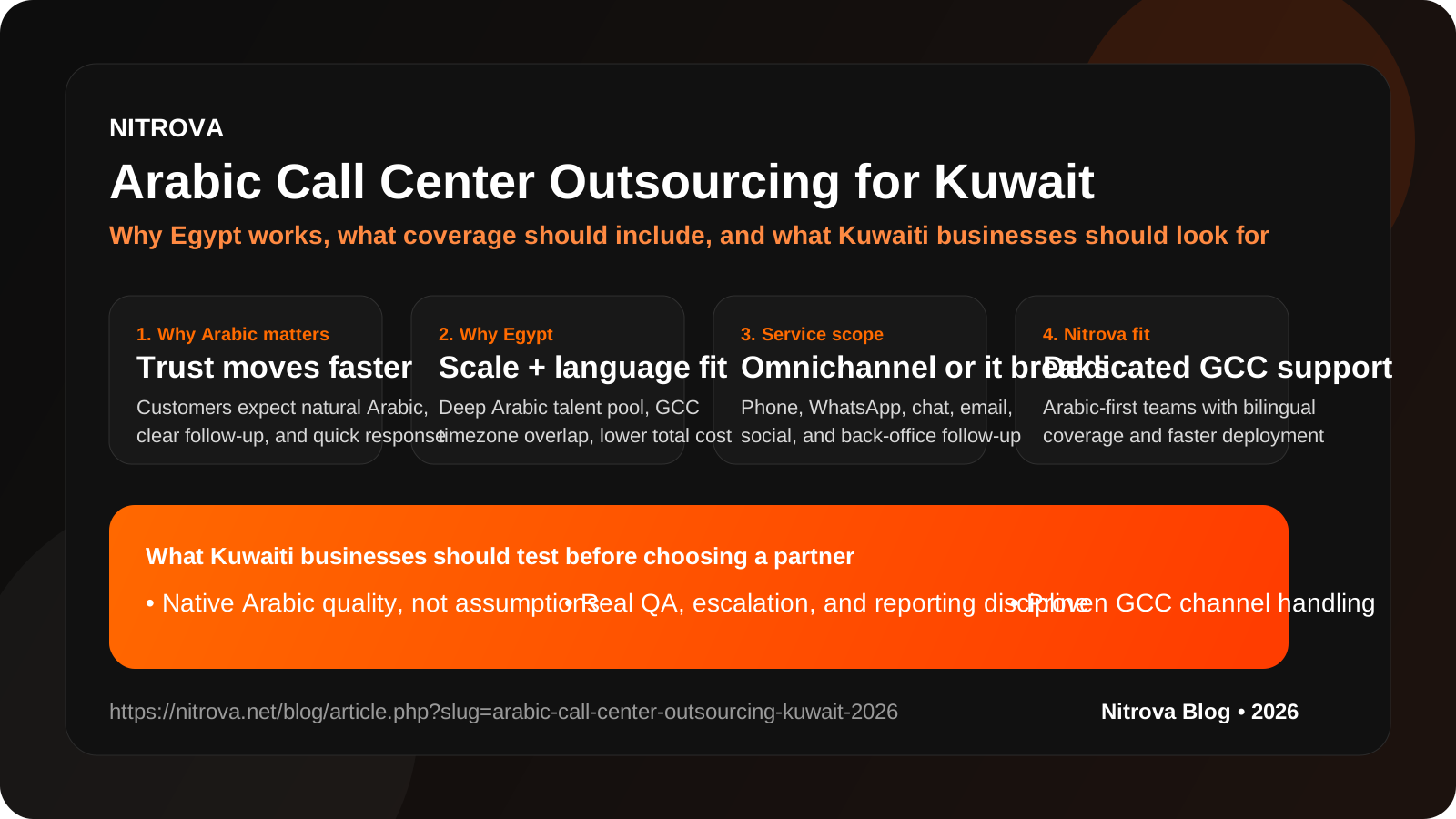
Why Kuwaiti Companies Outsource Arabic Customer Support
Kuwaiti businesses rarely look for an external call center because outsourcing sounds fashionable. The pressure is usually operational. Response times stretch during evening peaks, WhatsApp queues spill into personal phones, customers repeat the same issue across several channels, and support starts to feel inconsistent in Arabic.
At that point, customer service stops being an internal workload problem and becomes a commercial one. Slow replies, weak follow-up, and unnatural Arabic communication can affect cancellations, reviews, repeat purchase, referrals, and overall trust.
That is why Arabic call center outsourcing for Kuwait is increasingly evaluated as a revenue and customer experience decision, not only a cost decision. The goal is to build a support layer that can answer quickly, communicate naturally, and stay consistent across phone, WhatsApp, live chat, email, and social channels.
Why Arabic-Language Support Matters in Kuwait
Arabic support quality is not just about whether an agent can understand the customer. Kuwaiti customers expect clarity, confidence, and familiarity in the way service is delivered. Modern Standard Arabic matters, but so does Gulf-market awareness and the ability to communicate without sounding robotic or culturally disconnected.
- Customers escalate faster when they do not feel understood in Arabic.
- Peak-hour delays on phone and WhatsApp can create immediate frustration.
- Non-native communication can introduce avoidable errors in complaints, account explanations, and order updates.
- Weak Arabic support can damage trust in markets where referrals and word-of-mouth remain important.
For that reason, many businesses connect Arabic coverage directly to their wider customer support outsourcing strategy instead of treating it as an add-on.
Why Egypt Is a Practical Base for Customer Support Outsourcing to Kuwait
Egypt is a strong operating base for Arabic customer support because it combines a large talent pool, native Arabic communication, close GCC timezone alignment, and a cost structure that is generally more efficient than building the same function entirely in-house in Kuwait.
The advantage is broader than payroll. An in-house support team also requires recruitment, training, quality monitoring, workforce scheduling, supervision, systems, reporting, and backup coverage. An outsourced model can reduce that total operational burden while giving the company more flexibility to scale.
Management view: the value of Egypt is not only lower cost. It is the ability to build Arabic-speaking support capacity faster, with clearer operating control, without waiting through a long internal hiring cycle.
In-House Support in Kuwait vs. Outsourcing to Egypt
| Area | In-House Team in Kuwait | Egypt-Based Outsourcing |
|---|---|---|
| Recruitment | Internal hiring and screening | Provider manages recruitment and staffing |
| Arabic language fit | Depends on local hiring pool | Large native Arabic-speaking talent base |
| Training | Built and managed internally | Can be structured with the outsourcing partner |
| QA and supervision | Requires internal management capacity | Can be included in the managed service |
| Scaling | Additional hiring cycles required | Team size can be expanded more flexibly |
| Operating cost | Higher fixed internal burden | More flexible cost structure in many cases |
| Timezone alignment | Local | Strong overlap between Egypt and Kuwait |
What Arabic Call Center Outsourcing for Kuwait Should Include
A serious outsourcing setup should cover more than inbound calls. Customers move across channels quickly, and operations break down when each channel is handled separately.
- Inbound customer service: phone, live chat, email, and WhatsApp.
- Outbound calling: follow-up, lead qualification, renewals, reminders, and win-back campaigns.
- Social media support: handling DMs, comments, complaints, and escalation.
- Technical support routing: supported by a dedicated technical support function when issues go beyond basic service questions.
- Back-office coordination: order updates, case logging, data checks, ticket follow-up, and status tracking.
- Bilingual coverage: Arabic and English support for businesses serving mixed customer bases.
A provider that only answers calls but leaves the rest of the process fragmented internally may reduce call volume without fixing the underlying customer experience.
Can Kuwaiti Companies Outsource WhatsApp Support Only?
Yes. Some businesses begin with a single high-volume channel such as WhatsApp, live chat, or phone. This can be a useful starting point when one channel is creating the most operational pressure.
However, the long-term setup should consider the full customer journey. A customer may start on WhatsApp, continue by phone, and later follow up by email. If those interactions are not connected, the customer ends up repeating the same story several times.
Industries in Kuwait That Benefit Most from Outsourced Arabic Support
Arabic customer support outsourcing can be especially useful in sectors where response time, repeat communication, and customer trust are commercially important.
- E-commerce: order status, returns, delivery issues, refunds, and product questions.
- Fintech and financial services: account support, onboarding guidance, payment questions, and escalation routing.
- Healthcare: appointment coordination, patient communication, reminders, and non-clinical support.
- Real estate: lead response, viewing coordination, follow-up, and client communication.
- Logistics: shipment tracking, delivery updates, issue resolution, and customer notifications.
- Education: enrollment support, student communication, course inquiries, and scheduling.
Why Egypt Instead of Other Outsourcing Destinations?
Companies evaluating outsourcing often compare several delivery locations. For a Kuwait-focused operation, Egypt has a specific advantage: Arabic communication is native, the business culture is regionally familiar, and working hours overlap naturally with GCC markets.
Other offshore destinations may offer scale, but they do not always provide the same Arabic-language depth or Gulf-market familiarity. For businesses where Arabic support is central to the customer experience, that difference matters.
Egypt can also support functions beyond customer service, including virtual assistance, technical support, operations coordination, and other remote staffing functions.
How to Choose an Arabic-Speaking Outsourcing Partner for Kuwait
The right partner should be evaluated on operating details rather than generic claims. A useful selection process should include the following questions:
- How is Arabic fluency assessed during hiring?
- Does the provider have experience with GCC-facing customers?
- Who owns quality monitoring and coaching?
- What happens when a complaint needs escalation?
- How are KPIs, QA scores, and service levels reported?
- Can the provider support phone, WhatsApp, chat, email, and social media?
- How quickly can the team scale during seasonal peaks?
- What does the first two weeks of onboarding actually look like?
It is also worth reviewing the provider itself. Companies evaluating Nitrova can learn more about Nitrova, review its customer support services, or contact the team directly.
How to Compare Cost Without Choosing the Cheapest Provider
The lowest quoted price is not always the lowest operating cost. A cheaper provider can become expensive if language quality is weak, agent turnover is high, escalations are poorly handled, or managers spend hours fixing avoidable mistakes.
A more useful cost comparison should include:
- Recruitment and replacement cost.
- Training time and ramp-up.
- QA and supervision.
- Coverage hours and peak scheduling.
- Technology and reporting.
- Management time spent on escalations.
- Impact of poor support on retention and repeat sales.
For this reason, businesses should compare total operating burden rather than agent salary alone.
Nitrova for Kuwaiti and GCC Businesses
Nitrova supports Kuwait and wider GCC companies through Arabic-speaking teams built from Egypt, with a focus on communication quality, operational consistency, and fast deployment.
Depending on the operation, that can include omnichannel customer service, bilingual Arabic and English coverage, technical support coordination, remote staffing, and dedicated team structures.
For businesses comparing options, Nitrova's practical advantages include:
- Native Arabic-speaking agents with GCC-facing communication familiarity.
- Coverage across phone, chat, email, WhatsApp, and social channels.
- Bilingual Arabic and English support where required.
- Dedicated account handling rather than a loose rotating labor pool.
- Flexible team sizing as support volume changes.
- Faster deployment than building the same support structure internally from zero.
When Should a Kuwait Business Outsource Customer Support?
The strongest time to outsource is usually before service pressure becomes a customer retention problem. Warning signs include rising response times, unanswered WhatsApp messages, founders or managers getting pulled into customer complaints, inconsistent Arabic quality, and frequent hiring problems.
If support demand is growing faster than the internal team, outsourcing can create breathing room while adding structure around QA, reporting, staffing, and escalation.
Final Takeaway
For Kuwaiti companies evaluating Arabic call center outsourcing or customer support outsourcing, Egypt offers a strong combination of native Arabic communication, GCC timezone alignment, talent availability, and operating flexibility.
The key is not to outsource simply to reduce payroll. The better goal is to build a support operation that responds faster, communicates more naturally, scales more easily, and gives management better control over service quality.
If you want to review fit, coverage, team structure, or deployment speed for your operation, book a conversation with Nitrova or email the team with your current support channels, volume, and service gaps.