How should Saudi companies think about customer support cost in 2026?
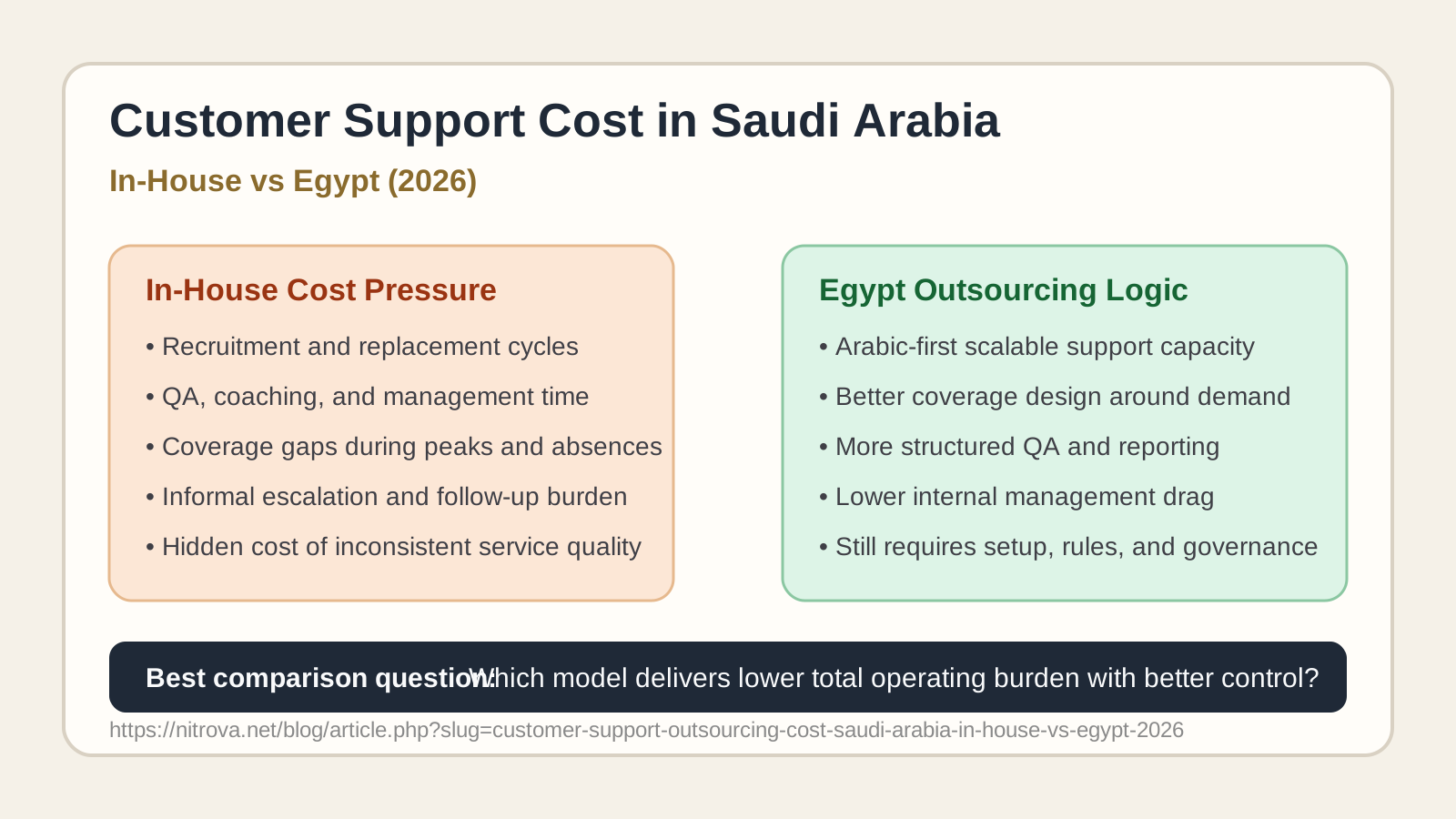
They should think about customer support cost as an operating system cost, not just a payroll line. A Saudi company may look at one internal hire versus one outsourced seat, but that comparison misses the real pressure points: recruitment time, shift coverage, Arabic quality control, supervision, replacement risk, reporting, and how unresolved cases are followed through.
That is why customer support outsourcing cost in Saudi Arabia is rarely a simple price question. It is a decision about which model creates lower operating burden while still protecting customer experience.
Is in-house support or outsourcing from Egypt usually more cost-efficient?
Outsourcing from Egypt is often more cost-efficient when a Saudi company needs scalable Arabic support, wider coverage, and stronger process discipline without building a heavy internal layer. But it is not automatically the better choice in every case.
The more accurate question is this: which model gives the company the right mix of coverage, quality, control, and management effort for the lowest total operating burden? Some teams need tight internal ownership. Others mainly need a reliable customer support engine that does not keep pulling managers into routine cases.
What costs do Saudi companies often miss when they build support in-house?
The hidden cost of in-house support is usually not the first salary. It is everything that comes after the hire. Saudi businesses often underestimate how much support quality depends on staffing continuity, shift planning, coaching, escalation handling, and the day-to-day attention needed to keep service stable.
- Recruitment time and the cost of hiring slowly or hiring twice.
- Onboarding and knowledge transfer before agents can work independently.
- Supervision time from operations or customer experience managers.
- QA and coaching needed to keep Arabic quality and brand tone consistent.
- Coverage pressure during evenings, campaigns, promotions, and absences.
- Replacement hiring when turnover or performance gaps appear.
- Follow-up friction when support touches logistics, billing, or technical teams.
For many Saudi companies, these costs matter more than the headline salary because they affect both customer experience and management focus.
What costs are easy to underestimate in an outsourced model?
Outsourcing also has real operating costs, but they tend to show up in a different place. The buyer still needs onboarding, process design, escalation rules, and clear ownership boundaries. An outsourced model does not eliminate management. It changes what management is managing.
- Initial setup and workflow mapping.
- Knowledge base creation or cleanup.
- Access rules for CRM, helpdesk, or order-management systems.
- Escalation design between the provider and internal team.
- Quality review during ramp-up.
- Ongoing governance and reporting reviews.
The difference is that these costs usually sit inside a more structured delivery model rather than being absorbed informally across internal staff.
How should a Saudi buyer compare in-house support with outsourcing from Egypt?
A Saudi buyer should compare the two models across control points, not just monthly expense. The better model is the one that handles customer demand with less management drag and fewer service breakdowns.
| Area | In-House Support | Outsourced Support from Egypt |
|---|---|---|
| Hiring burden | Company owns recruitment, onboarding, and replacement | Provider absorbs more of the staffing burden |
| Arabic delivery | Depends on current hiring quality and supervision | Can draw from a larger Arabic-speaking talent base |
| Coverage flexibility | Harder to expand around peaks without new hiring | Usually easier to redesign around support demand |
| Management load | Higher day-to-day oversight inside the company | More delivery structure, but still needs governance |
| QA discipline | Must be built and maintained internally | Can be built into the operating model more directly |
| Escalation flow | May stay informal if the team is small | Needs explicit rules but can become more consistent |
| Reporting visibility | Depends on internal process maturity | Can be designed with clearer service reporting |
What should stay in-house and what can be outsourced?
The strongest customer support model is often hybrid rather than absolute. A Saudi company does not need to outsource every support decision just because it outsources support delivery.
What often stays in-house:
- Final authority over refunds, exceptions, and policy decisions.
- Leadership ownership of customer experience strategy.
- Sensitive account decisions or high-risk complaint handling.
- Internal coordination with finance, legal, or executive escalation.
What can often be outsourced effectively:
- Day-to-day ticket or inbox handling.
- Arabic-first customer conversations.
- Routine follow-up and status communication.
- Predefined escalation routing.
- Structured reporting and queue discipline.
This is one reason cost comparisons become more useful when framed around operating design instead of all-or-nothing staffing.
Why do Saudi companies compare Egypt specifically?
Saudi companies compare Egypt because it is often a practical operating base for Arabic-first customer support. The advantage is not a vague regional claim. It is the practical combination of Arabic capability, bilingual support when needed, timezone alignment, and the ability to scale without forcing a full local hiring cycle.
That matters especially for businesses handling high conversation volume, multi-channel support, or fast-changing workload. Egypt can be a strong fit when the company wants support capacity that feels operationally close to Saudi business hours and customer expectations.
When does in-house support still make more sense?
In-house support still makes more sense when the service environment is deeply tied to sensitive systems, highly specialized internal knowledge, or close daily executive control. Some Saudi companies need a support function that sits physically or organizationally inside the business because exceptions are frequent and leadership wants direct involvement.
That can also be true when support is tightly tied to premium relationship management, regulated workflows, or complex internal handoffs that are still too immature to externalize cleanly.
When does outsourcing from Egypt make more sense?
Outsourcing from Egypt makes more sense when the company needs stronger Arabic support capacity, more predictable coverage, lower internal management drag, and a more disciplined queue model than the current internal setup can sustain. It is often attractive when leadership is spending too much time solving routine support friction.
Typical signs include recurring backlog, uneven response quality, weak follow-up discipline, difficulty scaling around peaks, or too much dependence on individual staff members to hold the service together.
How should a Saudi company evaluate providers on cost without chasing the cheapest quote?
It should evaluate providers on how much operating burden they actually remove. A lower quote is not automatically a lower-cost model if it still leaves the company managing quality issues, scattered escalation, or weak reporting internally.
- How much staffing burden does the provider absorb?
- How is Arabic quality reviewed and improved?
- How are shifts, peaks, and absences handled?
- How clear is the escalation model?
- What visibility will the company have into queue performance?
- How much internal supervision will still be needed weekly?
It is also sensible to review the provider in the context of related capabilities such as customer support services, technical support, virtual assistance, and the company's broader operating background.
Why might Nitrova fit this use case?
Nitrova can fit Saudi companies that want customer support from Egypt with stronger Arabic delivery, better structure, and a lower internal operating burden than an improvised in-house setup. The value is not only external staffing. It is the ability to put process, coverage design, and service consistency around a support function that may already be consuming too much internal time.
The fit is stronger when the company wants a practical model that still keeps policy control and sensitive decisions inside the business while moving routine support delivery into a more scalable structure.
Final takeaway
Customer support outsourcing cost in Saudi Arabia should be judged by total operating burden, not by salary alone. The real comparison is not local hire versus external seat. It is fragmented support management versus a support model that can hold quality, coverage, escalation, and reporting together more reliably.
If your company is spending too much management attention on routine support, struggling to scale Arabic delivery, or carrying hidden cost through weak follow-up and service inconsistency, the better question is not whether outsourcing is cheaper on paper. It is whether the in-house model is still the right operating fit.
To evaluate the right model, share your current channels, required coverage hours, language mix, escalation pressure, and internal management pain points through Nitrova's contact page or by email at hello@nitrova.net.
Frequently asked questions
Is outsourced customer support from Egypt always cheaper than hiring in-house in Saudi Arabia?
Not always. Outsourcing from Egypt can reduce total operating burden in many cases, but the better-cost model depends on coverage hours, language needs, workflow complexity, supervision, and how much of the support function the company wants to keep internally.
What costs do Saudi companies often miss when building an in-house support team?
They often underestimate recruitment time, replacement hiring, QA supervision, shift coverage pressure, management attention, onboarding, and the cost of inconsistent follow-up across channels.
What should stay in-house even if support is outsourced?
Sensitive policy decisions, commercial exceptions, escalation ownership at leadership level, and final authority over refunds, tone, and customer experience strategy often stay in-house even when day-to-day support delivery is outsourced.
Why do Saudi companies compare Egypt specifically for customer support outsourcing?
Because Egypt is a practical option for Arabic-first support, bilingual delivery when needed, timezone alignment with Saudi operations, and scalable staffing without forcing a heavy local hiring cycle.
When does in-house support still make more sense?
In-house can make more sense when the support workflow is deeply tied to sensitive internal systems, highly specialized products, or a customer experience model that leadership wants to supervise very closely day to day.
How can Nitrova fit Saudi companies evaluating customer support cost?
Nitrova can fit Saudi companies that want Arabic-capable customer support from Egypt with clearer operational structure, better coverage design, and lower internal management burden than an improvised internal setup.