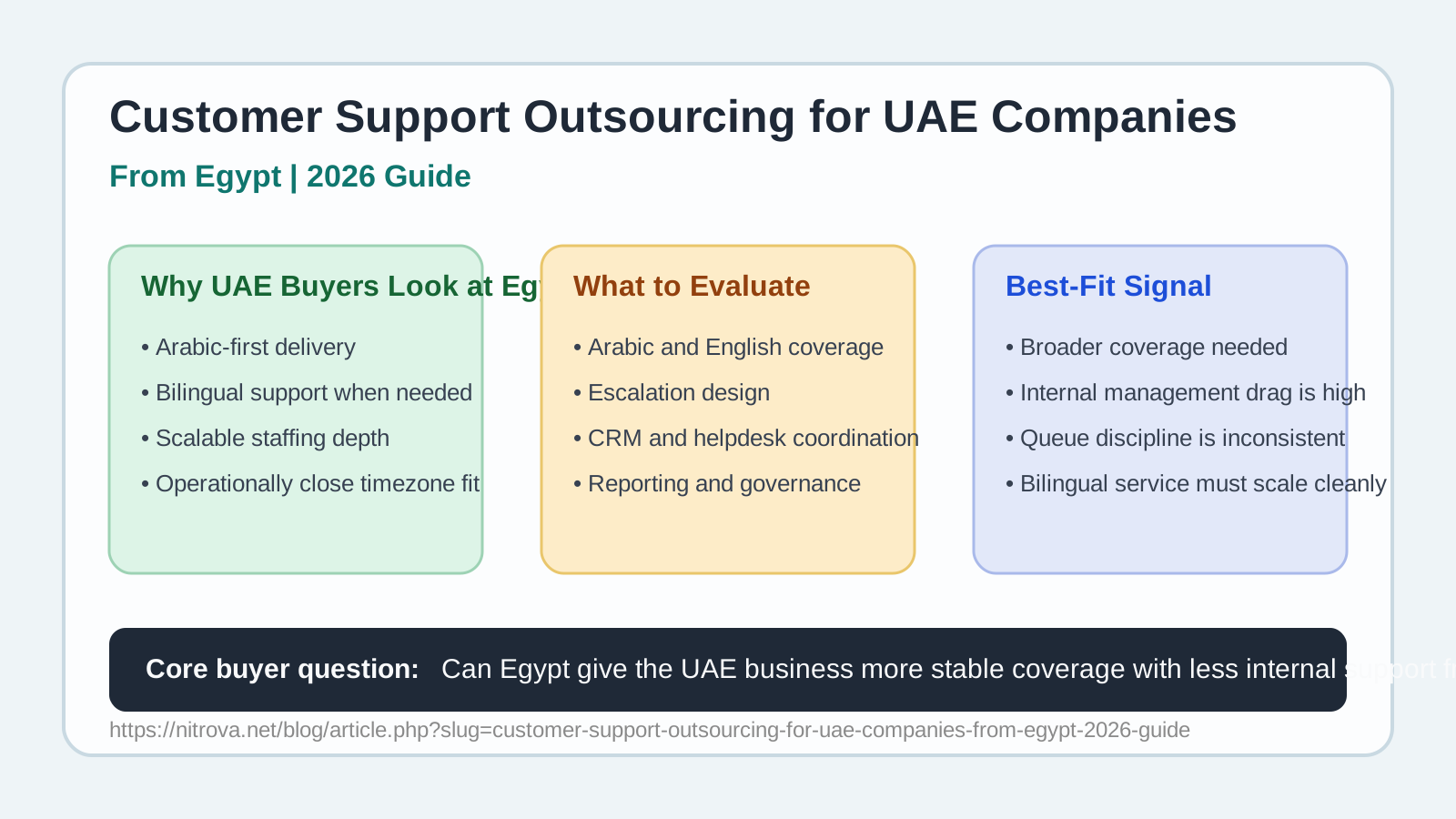
Why are more UAE companies evaluating customer support outsourcing from Egypt in 2026?
Because many UAE companies no longer struggle with customer support only because of ticket volume. They struggle because support has to stay consistent across Arabic and English conversations, longer service windows, fast-moving commercial activity, and internal handoffs between teams. The problem is often operational complexity, not just workload.
That is why customer support outsourcing for UAE companies from Egypt has become a practical buying question. The decision is not simply whether to move support outside the business. It is whether the current operating model still gives the company enough coverage, consistency, and management control.
When does outsourcing customer support make sense for a UAE company?
Outsourcing makes sense when the internal team is spending too much energy holding the support function together instead of improving it. If queue ownership is weak, follow-up depends on individuals, or managers keep stepping into routine issues, the business may already be carrying more support friction than it should.
This usually becomes visible when the company needs better Arabic handling, bilingual support, wider coverage, or stronger structure across channels without building a heavier internal team too quickly.
Why do UAE companies compare Egypt specifically for customer support?
They compare Egypt because it is often a practical delivery base for Arabic-first and bilingual customer support. The advantage is not a generic regional claim. It comes from the combination of natural Arabic communication, broader staffing depth, timezone compatibility, and the ability to scale support in a way that stays operationally close to UAE business needs.
That makes Egypt especially relevant for companies that need customer support to work across voice, email, chat, WhatsApp, or mixed-service workflows without turning every growth phase into a fresh internal hiring problem.
Can outsourced support from Egypt handle both Arabic and English for UAE businesses?
Yes. Outsourced support from Egypt can handle both Arabic and English when the model is designed deliberately around the right language mix. For many UAE businesses, the issue is not choosing one language over the other. It is making sure customer journeys stay coherent when conversations move across segments, agents, and channels.
That is why buyers should not ask only whether a provider can staff Arabic and English. They should ask how the provider will manage language quality, handoff logic, and escalation discipline across a bilingual service environment.
What operating pressure usually pushes UAE companies toward outsourcing?
The pressure usually comes from one or more of these issues:
- Coverage expectations extending beyond a small internal team's practical capacity.
- Arabic quality becoming inconsistent across agents or shifts.
- Customer conversations getting stuck between support, operations, billing, or technical teams.
- Managers spending too much time supervising routine support flow.
- Growth creating more channel complexity than the current team structure can absorb.
These are not just staffing problems. They are signs that support may need a better operating structure.
How should UAE companies compare in-house support with outsourcing from Egypt?
They should compare the models on operational control, not on headcount alone. The stronger model is the one that gives the company more reliable service quality with less internal drag.
| Area | In-House Support | Outsourced Support from Egypt |
|---|---|---|
| Arabic handling | Depends on current hiring quality and coaching | Can use a wider Arabic-speaking talent base |
| English support continuity | May depend on a small internal team structure | Can be built into a broader coverage plan |
| Coverage design | Harder to widen without new internal layers | Can usually be structured more flexibly |
| Management burden | More direct internal supervision day to day | More structure, but still requires governance |
| Escalation flow | Can remain informal if processes are immature | Can be designed with clearer routing rules |
| Reporting visibility | Depends on internal process maturity | Can be made more explicit through service reporting |
What should stay inside the UAE company and what can be outsourced?
The best model is often hybrid. A company does not need to outsource every part of customer support just because it outsources delivery capacity.
What often stays inside the company:
- Policy ownership and sensitive commercial exceptions.
- Final authority over refunds, compensation, or relationship-sensitive cases.
- Brand-level experience decisions and escalation ownership.
- Internal coordination with leadership, finance, or regulated functions.
What can often be outsourced effectively:
- Day-to-day customer conversations.
- Arabic-first support delivery.
- Bilingual queue management where the workflow is clear.
- Routine follow-up and case progression.
- Structured reporting and queue discipline.
This is why mature buyers usually compare operating design instead of asking whether everything should stay inside or move outside.
What should UAE buyers evaluate before choosing a support partner from Egypt?
They should evaluate whether the provider understands the service environment they actually run. The right questions are practical, not generic.
- How is Arabic quality reviewed and improved over time?
- How will Arabic and English coverage be balanced?
- How are escalations routed across support, operations, and technical teams?
- What systems or workflows will the team use for CRM, helpdesk, or order visibility?
- How much internal supervision will still be required from the client side?
- What reporting structure will give leadership real service visibility?
It is also useful to review the provider alongside related capabilities such as customer support services, technical support, virtual assistance, and the company's broader operating background.
When does outsourcing from Egypt make more sense than expanding internally?
It makes more sense when the company needs broader coverage, more consistent Arabic delivery, stronger queue discipline, or a lighter management burden than its current internal setup can sustain. This often happens when growth is increasing service complexity faster than leadership wants to expand internal support management.
If the team is already dealing with recurring backlog, weak handoffs, inconsistent quality, or too much dependence on specific employees, the issue is usually no longer short-term. It is structural.
Why might Nitrova fit UAE companies evaluating customer support outsourcing?
Nitrova can fit UAE companies that want customer support from Egypt with clearer operational structure, stronger Arabic delivery, and service models that support bilingual customer journeys when needed. The value is not only external staffing capacity. It is the ability to turn support into a more reliable operating function instead of a constantly expanding internal coordination problem.
The fit is stronger when the company wants to keep policy control and sensitive escalation inside while moving daily support delivery into a model with better coverage and process discipline.
Final takeaway
Customer support outsourcing for UAE companies from Egypt is not just a cost question. It is a service design question. The core issue is whether the business needs a more scalable, better-structured support layer than the internal model can comfortably provide.
If support quality, bilingual consistency, escalation flow, or management attention are already under pressure, outsourcing may be less about reducing payroll and more about improving operational fit.
To evaluate the right setup, share your current channels, language mix, coverage expectations, escalation pressure, and the operational friction points affecting your team through Nitrova's contact page or by email at hello@nitrova.net.
Frequently asked questions
Why do UAE companies outsource customer support from Egypt?
They often do it to build Arabic-first or bilingual support with more flexible coverage, lower internal management pressure, and easier scaling than an improvised internal setup.
Can outsourced support from Egypt handle both Arabic and English for UAE businesses?
Yes. Many UAE companies need a mix of Arabic and English support, and Egypt can be a practical base when the operating model is designed around the right language mix and escalation flow.
What should stay inside a UAE company even if support is outsourced?
Policy control, sensitive escalations, brand decisions, and final authority over exceptional cases often stay inside the company even when day-to-day support delivery is outsourced.
When does outsourcing customer support make more sense than expanding internally?
It usually makes more sense when the business needs broader coverage, stronger queue discipline, more stable Arabic handling, or less day-to-day management involvement than the internal setup can provide.
What should UAE buyers evaluate before choosing a support partner from Egypt?
They should evaluate language quality, coverage design, escalation rules, CRM or helpdesk coordination, reporting visibility, and how much internal supervision will still be required.
How can Nitrova fit UAE companies evaluating customer support outsourcing?
Nitrova can fit UAE companies looking for customer support from Egypt with stronger operational structure, clearer coverage design, and service models that support Arabic and bilingual customer journeys.