A Saudi e-commerce team can look busy and still be losing control of the basics. Product titles get updated in one place but not another. A delivery note sits in the wrong field. A refund request is waiting for an internal check. The founder asks why support keeps repeating the same questions, and the answer is not always a weak support team. Often, the data and admin layer behind support is too thin.
That is the buying question this article answers: when should a Saudi e-commerce company outsource back-office support instead of hiring another internal coordinator? The short answer is: when repeat admin work is now affecting customer experience, management focus, and order accuracy, but the work does not require a senior internal employee every hour of the day.
For Nitrova, this sits closest to Virtual Assistance, with natural overlap into Customer Support. The goal is not to replace operational ownership inside the company. It is to give Saudi founders, COOs, and operations managers a controlled execution layer for tasks that must be done carefully, repeatedly, and on time.
What problem does e-commerce back-office outsourcing actually solve?
Back-office outsourcing solves the operational drag between sales, customer support, fulfillment, and management. It is useful when small admin delays start creating visible customer problems, such as unclear order status, missing product information, delayed return checks, or inconsistent CRM records.
In many Saudi stores, the visible channels are obvious: website, marketplace, WhatsApp, Instagram, phone, email, and delivery coordination tools. The hidden workload is less visible. Someone has to clean product records, update stock notes, tag orders correctly, prepare support context, follow up on pending cases, and keep internal trackers readable. When that work sits with the founder or a senior operations person, it becomes expensive even if no invoice shows it.
The practical value of outsourcing is not that a remote assistant is magically cheaper. The value is that repeatable tasks move into a managed routine. Internal leaders can then focus on vendor decisions, merchandising, customer promises, and exception handling instead of copying data between tools.
Which Saudi e-commerce tasks are suitable for outsourced back-office support?
The best tasks are recurring, process-driven, and easy to QA. They should be important enough to affect operations, but structured enough that an external team can complete them using clear rules, approved access, and escalation boundaries.
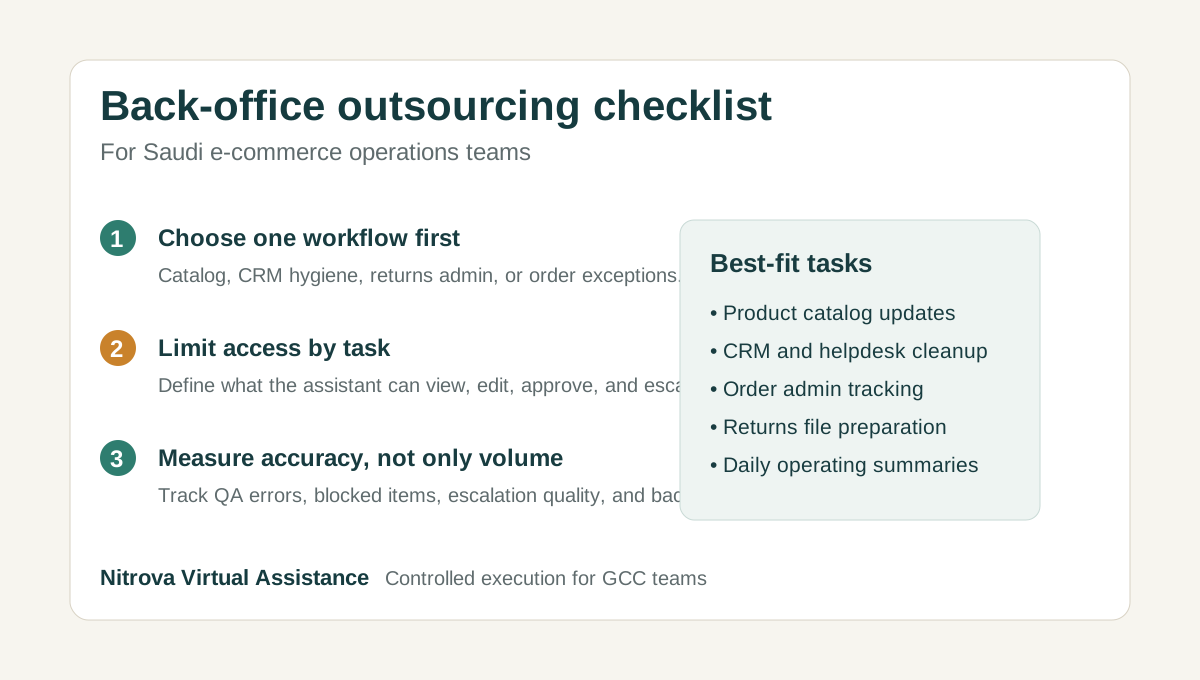
- Product catalog updates, including titles, descriptions, tags, images status, and category placement.
- CRM and helpdesk cleanup, including labels, order references, buyer notes, and follow-up statuses.
- Order admin support, such as checking incomplete fields, preparing daily exception lists, and coordinating internal handoffs.
- Returns and refund admin, where the team collects required details and prepares cases for approval without making unsupported financial decisions.
- Marketplace and website coordination tasks, when product or order records need consistent updates across multiple systems.
- Reporting preparation, such as daily backlog summaries, unresolved cases, and recurring error categories.
Tasks that involve pricing strategy, refund approval, vendor negotiations, or sensitive customer decisions should usually stay under direct company control. An outsourced assistant can prepare the file and surface the exception, but the business should define who owns the final decision.
When is outsourcing better than hiring another internal coordinator?
Outsourcing is usually better when the work is steady but fragmented, requires process discipline, and does not justify another full internal management layer. Hiring internally is stronger when the role needs constant physical coordination, commercial authority, or deep company-specific decision making.
| Decision point | Internal hire may fit | Outsourced support may fit |
|---|---|---|
| Workload pattern | One broad role with many sensitive decisions | Repeatable daily tasks across catalog, CRM, and admin |
| Management need | Close supervision by founders or operations leadership | Clear SOPs, QA review, and structured reporting |
| System access | Full access to commercial and financial tools | Limited role-based access to assigned workflows |
| Scaling need | Stable workload with little seasonal movement | Workload changes during launches, campaigns, or peak periods |
| Decision authority | The person must approve exceptions directly | The person prepares exceptions and escalates them |
A common mistake is treating outsourcing as a way to avoid management. It is not. The cleaner model is to keep ownership in Saudi Arabia and move execution to a trained assistant or small team. The internal manager still defines priorities, approves exceptions, and reviews performance. The outsourced team handles the repetitive operational load.
Dedicated assistant or shared team: which model should a Saudi store choose?
A dedicated assistant is better when daily context matters. A shared team is better when tasks are limited, standardized, and do not require deep familiarity with your product catalog or internal exceptions.
For an early-stage store, shared support may be enough for weekly catalog cleanup, spreadsheet preparation, or simple reporting. Once the store has frequent SKUs changes, multiple channels, internal handoffs, or recurring order exceptions, a dedicated assistant becomes easier to train and measure. The dedicated model also reduces repeated explanations because the assistant builds memory around product families, supplier rules, tone, and common operational issues.
The question is not which model sounds more professional. The question is how much context the work requires. If each task depends on yesterday's decisions, a named assistant is usually safer. If the task can be completed from a checklist with minimal judgment, a shared model can be efficient.
How should access and data boundaries be managed?
Access should be role-based, limited, and tied to specific tasks. Before any outsourced assistant enters a CRM, helpdesk, marketplace dashboard, or order management tool, the Saudi company should define what the team can view, edit, export, approve, and escalate.
Good operating boundaries are practical, not theoretical. For example, an assistant may be allowed to update product tags but not change pricing. They may prepare refund files but not approve refunds. They may tag high-risk order issues but not promise compensation to customers. They may update CRM notes but not export customer lists unless explicitly approved.
This matters because back-office work often touches customer data, payment context, and operational decisions. Nitrova's role should be framed around controlled execution: agreed tasks, defined access, documented handoffs, and reviewable outputs. The client should keep ownership of policy, approvals, and sensitive decisions.
What should the first 30 days include?
The first month should prove control before scale. A Saudi e-commerce business should start with a narrow task list, a small set of tools, and a clear reporting rhythm before adding more workflows.
- Map the admin backlog: identify which tasks create the most delays or repeated support questions.
- Choose one workflow: start with catalog cleanup, CRM hygiene, returns admin, or order exception tracking rather than everything at once.
- Write simple rules: define field formats, naming conventions, escalation triggers, and approval limits.
- Limit access: give only the permissions required for the first workflow.
- Review daily outputs: check samples, exceptions, and mistakes before expanding scope.
- Convert learning into SOPs: turn repeated clarifications into knowledge-base notes and checklists.
This staged approach prevents a common outsourcing failure: handing over messy work without first deciding what good execution looks like. If the internal team cannot describe the process, the external team will guess. Guessing is where errors start.
How should performance be measured?
Performance should be measured by operational accuracy, backlog movement, escalation quality, and manager time saved. Avoid measuring only the number of completed tasks, because a fast assistant who creates downstream corrections is not helping the business.
- Backlog count by workflow, such as uncategorized products or unresolved admin cases.
- Error rate from QA samples, especially fields that affect customers or fulfillment.
- Escalation quality, including whether the assistant sends complete context to the right internal owner.
- Turnaround time for routine admin queues.
- Repeat issue categories, which can reveal broken templates, unclear rules, or system gaps.
- Manager review time, because the point is to reduce operational drag without losing control.
For a Saudi e-commerce operator, the right reporting format is often simple: daily completed work, blocked items, exceptions needing approval, and recurring issues. Long reports are less useful than a tight operating summary that helps the COO or operations manager decide what to fix next.
Why can Egypt be a practical delivery base for this work?
Egypt can be practical for Saudi e-commerce back-office support because the work benefits from Arabic capability, regional communication familiarity, timezone alignment, and a broad remote talent pool. These advantages are useful when tasks require both accuracy and coordination with Arabic-speaking support or operations teams.
The advantage should not be overstated. Egypt is not automatically the right answer for every workflow. It works best when the Saudi company has clear SOPs, controlled access, and someone internally accountable for decisions. In that model, an Egypt-based assistant can support daily admin without forcing the company to build every execution role in-house.
For Nitrova, the relevant positioning is practical: Arabic-capable virtual assistance, remote operational support, and structured handoffs for GCC businesses. That is different from claiming a universal cost saving or pretending every task can be moved outside the company. Some tasks should stay inside. Others simply need reliable execution.
What should a buyer ask before choosing a provider?
A buyer should ask how the provider will protect access, train the assistant, document tasks, measure quality, and handle mistakes. The provider's answers should be operational, not vague.
- Will the assistant be dedicated, shared, or a hybrid model?
- Who trains the assistant on tools, catalog rules, and internal workflows?
- How are mistakes logged, corrected, and prevented from repeating?
- What access does the assistant need, and what access is unnecessary?
- How are peak periods, campaigns, or product launches handled?
- Who owns escalation when an order, refund, or customer issue is sensitive?
- What reporting will the operations manager receive each day or week?
If a provider cannot discuss these questions clearly, the risk is not only poor admin work. The risk is that internal teams will spend more time supervising the outsourced workflow than they spent doing the work themselves.
How Nitrova can support the decision
Nitrova can help Saudi e-commerce teams think through which back-office workflows are suitable for remote execution, which tasks should stay internal, and whether a dedicated or shared assistant model makes sense. The conversation should start with operating reality, not a package name.
If you are considering support from Nitrova Virtual Assistance, prepare four details: team size, channels and tools, coverage hours, and the admin problems currently slowing your team down. From there, the scope can be shaped around catalog work, CRM hygiene, order admin, reporting, or a narrower workflow that proves value first. You can also learn more about Nitrova or contact the team to discuss fit.
FAQ
When should a Saudi e-commerce company outsource back-office support?
Outsourcing becomes practical when product updates, CRM cleanup, order admin, and routine marketplace tasks are slowing growth, distracting managers, or creating avoidable customer-facing errors.
Is back-office support the same as customer support?
No. Customer support handles buyer conversations, while back-office support keeps the operational data behind those conversations accurate, including product records, order notes, CRM fields, returns admin, and internal follow-ups.
Should a store use dedicated or shared back-office assistants?
A shared model can suit low-volume recurring admin, while a dedicated assistant is usually better when catalog changes, order workflows, or internal tools require daily context and brand-specific judgment.
What should be agreed before giving an outsourced team system access?
Define access boundaries, task ownership, escalation paths, QA checks, reporting format, and which actions require approval from the Saudi team before they are completed.