Remote accountants for Saudi companies are no longer a niche decision
A few years ago, many Saudi companies viewed remote accounting support as a temporary workaround. It was something a business tried when hiring locally was slow or when finance workload spiked for a quarter. That view is changing. In 2026, the conversation is more strategic. Companies are asking how to build accounting capacity without adding too much fixed cost too early, and how to give CFOs and founders cleaner numbers without forcing senior people to spend half their week inside reconciliations and routine bookkeeping.
This is where remote accountants for Saudi companies have become relevant in a more serious way. The need is especially visible in businesses that are scaling revenue faster than finance structure, or in firms where one internal finance manager is still handling bookkeeping, reconciliations, vendor coordination, reporting support, and sometimes even payroll follow-up. That model can survive for a while. Then the close gets slower, unresolved items accumulate, and management starts making decisions with less confidence than they should.
We see this often in service businesses, e-commerce operators, growing distributors, and SME groups that added business lines faster than they added finance process. The pain usually appears in small forms first: delayed reconciliations, recurring questions around missing entries, month-end figures that need too much manual correction, or a founder who still has to chase accounting updates personally.
Why Saudi companies are revisiting finance capacity in 2026
The wider business backdrop explains the timing. Monsha’at’s latest report hub shows continued attention on digital transformation in SMEs, and its 2024 digital transformation guide for SMEs highlighted that cloud-based platforms and digital government services are expanding the operating space for more technology-enabled businesses. The point is not just that Saudi companies are digitising. It is that finance functions now need to keep up with a business environment that moves faster, integrates more systems, and expects tighter operational visibility.
Grant Thornton Saudi Arabia also noted in April 2026 that outsourcing in Saudi Arabia is evolving beyond efficiency alone and that organisations now have to consider compliance, governance, and operating design when structuring outsourcing arrangements. That is exactly why the old question, "Can someone do the books remotely?" is too narrow. The better question is whether the finance operating model gives the company speed, control, and enough flexibility to scale.
A useful way to frame the choice: if the finance team spends most of its energy chasing routine accounting work, the company is paying senior-level attention to junior-level bottlenecks. Remote accounting support becomes valuable when it gives management time back without lowering control.
What remote accountants for Saudi companies should actually handle
Remote accountants are most useful when the company is clear about the layer they are expected to own. In many cases, the highest-value work sits in the middle of the finance stack rather than at the very top. That includes bookkeeping discipline, reconciliations, month-end schedules, management reporting support, payable and receivable follow-up, and keeping accounting records current enough for leadership to rely on them.
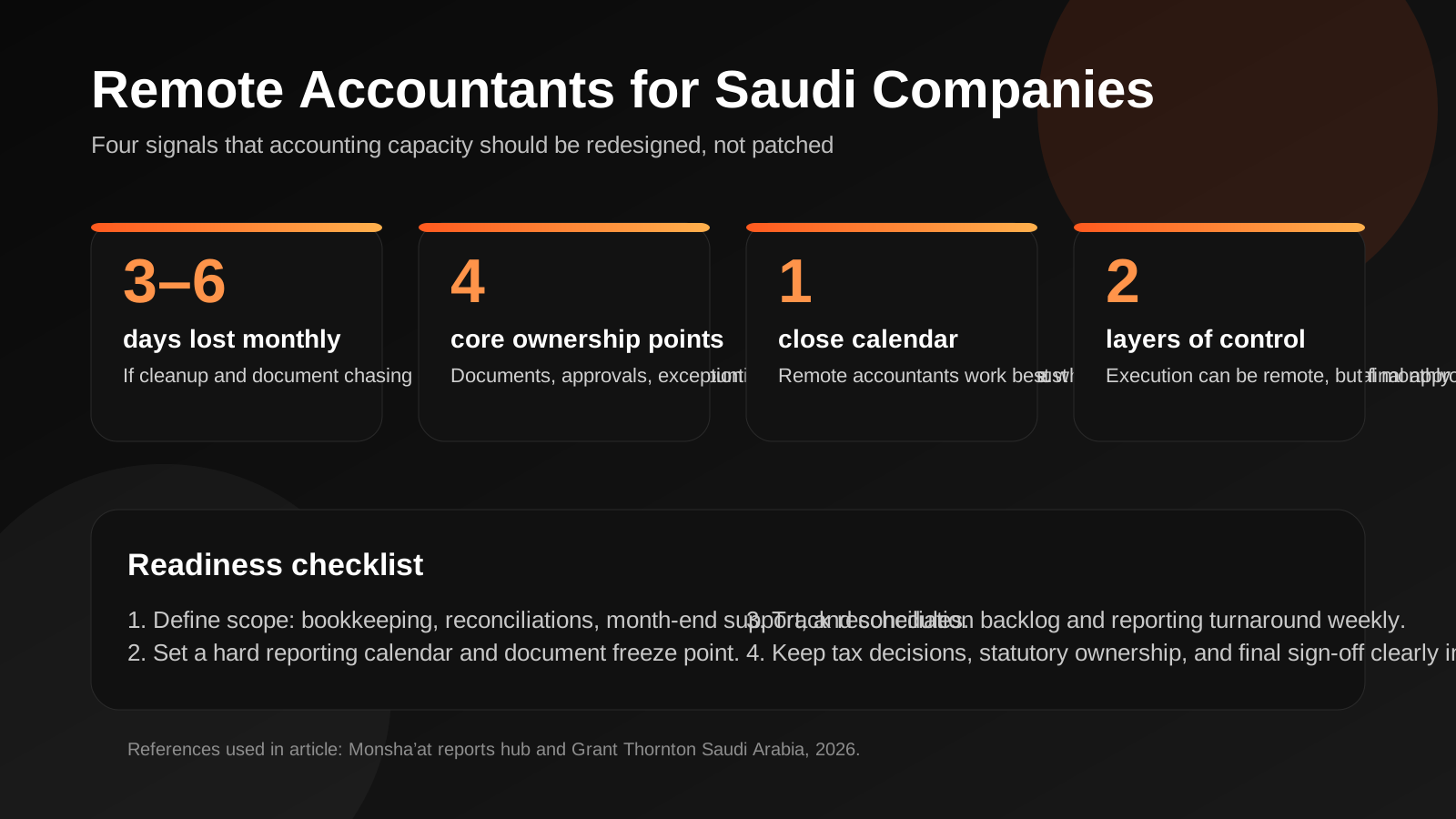
That does not mean every task should move outside. Final tax judgments, statutory decisions, local sign-off, and board-level finance interpretation usually still need to stay close to internal leadership or a local responsible owner. What works best is a split model: routine accounting production is strengthened by a dedicated remote team, while decision authority remains where it should.
For companies already thinking beyond basic bookkeeping, this can connect naturally with a broader Accounting & Finance staffing model. That is important because accounting bottlenecks rarely live alone. They often affect reporting, collections, vendor control, and management visibility at the same time.
Why Egypt is a practical source for remote accounting talent
For Saudi companies, Egypt works well when the goal is to build a dedicated accounting layer rather than outsource blindly by task. The attraction is partly about cost flexibility, but that is not the main story. The stronger reason is that Egyptian finance professionals can be embedded into a working process that supports Arabic communication, recurring coordination with management, and a rhythm that fits GCC business operations without forcing every detail through a fragmented freelance model.
What matters more than low cost is whether the team can stay consistent. Remote accountants who understand how to work within a fixed close calendar, maintain clean workpapers, and escalate issues before month-end are far more valuable than cheaper resources who only post entries without context. In practice, the businesses that benefit most are the ones that define ownership clearly from the beginning: who sends documents, who approves adjustments, who closes exceptions, and when the reporting window is considered frozen.
Where companies usually feel the pressure first
Month-end starts taking too long
This is one of the clearest signals. A business may still be profitable and growing, but if month-end numbers arrive too late, leadership is steering from the rear-view mirror. Slow close cycles usually mean the accounting workload has already outgrown the current structure.
Senior finance staff are buried in operating detail
When the finance manager or CFO is still chasing supplier reconciliations, cleaning ledgers, or following up on missing documents, the company is misusing senior bandwidth. Good finance leadership should spend time on analysis, forecasting, cash discipline, and risk, not on routine accounting catch-up.
The backlog is invisible until it becomes painful
Accounting pressure often hides well. A company may think the team is coping because daily operations still move. Then a financing conversation, audit request, tax review, or board pack deadline exposes how much unresolved work has been sitting quietly underneath.
Data points worth using in the internal business case
There are two useful market anchors here. First, Saudi SME growth and digital transformation continue to push companies toward more structured internal systems, as reflected in Monsha’at’s current reporting focus. Second, Grant Thornton’s 2026 view of outsourcing in Saudi Arabia makes it clear that governance and compliance now sit alongside efficiency in outsourcing design. The management takeaway is simple: the outsourcing decision should be measured by control and output quality, not just by saved salary line items.
A third internal number is often the most revealing of all: how many business days does the team lose every month to routine reconciliation cleanup, reporting corrections, and document chasing? If that answer is three to six days, then the accounting model is already costing more than leadership usually sees in the payroll line alone.
How to structure remote accountants for Saudi companies the right way
Start with a narrow scope, but not a vague one. "Support finance" is too broad to manage. A better opening scope might include bank reconciliations, receivable and payable schedules, monthly bookkeeping, supporting schedules for close, and management pack preparation. Once those areas stabilize, the team can take on more.
It also helps to build around a real finance calendar. When do invoices stop being accepted for the current cycle? When do intercompany questions need to be resolved? When is the first management view expected? Remote support only works well when the company gives the team a process to plug into rather than a pile of tasks to chase.
For businesses that also need adjacent support around operational systems or workflow cleanup, the connection between finance staffing and broader operational support can be valuable. Not every company needs that combination, but many fast-growing teams do.
How to evaluate a remote accounting partner
Ask how the partner handles documentation flow, review hierarchy, and issue escalation. Ask what a normal close calendar looks like. Ask how they prevent unresolved items from rolling silently into the next month. Ask what happens if the company’s internal approvals are the real bottleneck. Strong partners answer those questions with process detail, not general reassurance.
Another practical test is whether the partner thinks in terms of dedicated workflows or generic staffing. Dedicated support tends to work better because accounting quality depends on consistency. The team needs to understand the business logic behind recurring entries, not just the mechanics of posting them.
Frequently asked questions about remote accountants for Saudi companies
Are remote accountants suitable only for large Saudi companies?
No. Mid-sized companies often benefit sooner because their growth tends to outpace the maturity of their finance process, while internal headcount remains tight.
Can remote accountants replace internal finance leadership?
No. They strengthen execution capacity and process discipline, but leadership, final approval, and local responsibility still need clear internal ownership.
What is the biggest mistake in remote accounting setups?
The biggest mistake is starting with unclear ownership. If nobody knows who approves, who closes exceptions, and who owns the reporting calendar, the remote team will inherit confusion instead of solving it.
What should be measured in the first quarter?
At minimum: close speed, reconciliation backlog, reporting turnaround, unresolved exceptions, and how much senior management time is still being consumed by routine accounting work.
Closing view
The strongest finance teams are not always the biggest. They are the ones that keep routine accounting under control without forcing leadership back into operational noise every month. That is why remote accountants for Saudi companies have become a more serious operating decision in 2026. For many businesses, the issue is not whether accounting work exists. It is whether the current setup gives management timely, reliable numbers without absorbing too much internal energy.
If a Saudi company is already feeling strain in reconciliations, reporting, or close timing, that is usually the right moment to redesign the accounting layer before the backlog becomes normal. Done properly, a remote accounting team from Egypt can give the business more structure, more continuity, and more room for leadership to focus on decisions rather than finance cleanup.