Technical support used to sit quietly behind product and sales in many Gulf software companies. That is no longer true. Once a SaaS platform starts serving more merchants, more branch teams, more delivery riders, or more finance users across Saudi Arabia and the UAE, support becomes part of revenue protection. A login loop during a campaign launch, a failed integration after office hours, or a billing ticket left unanswered on WhatsApp can turn into churn faster than many founders expect.
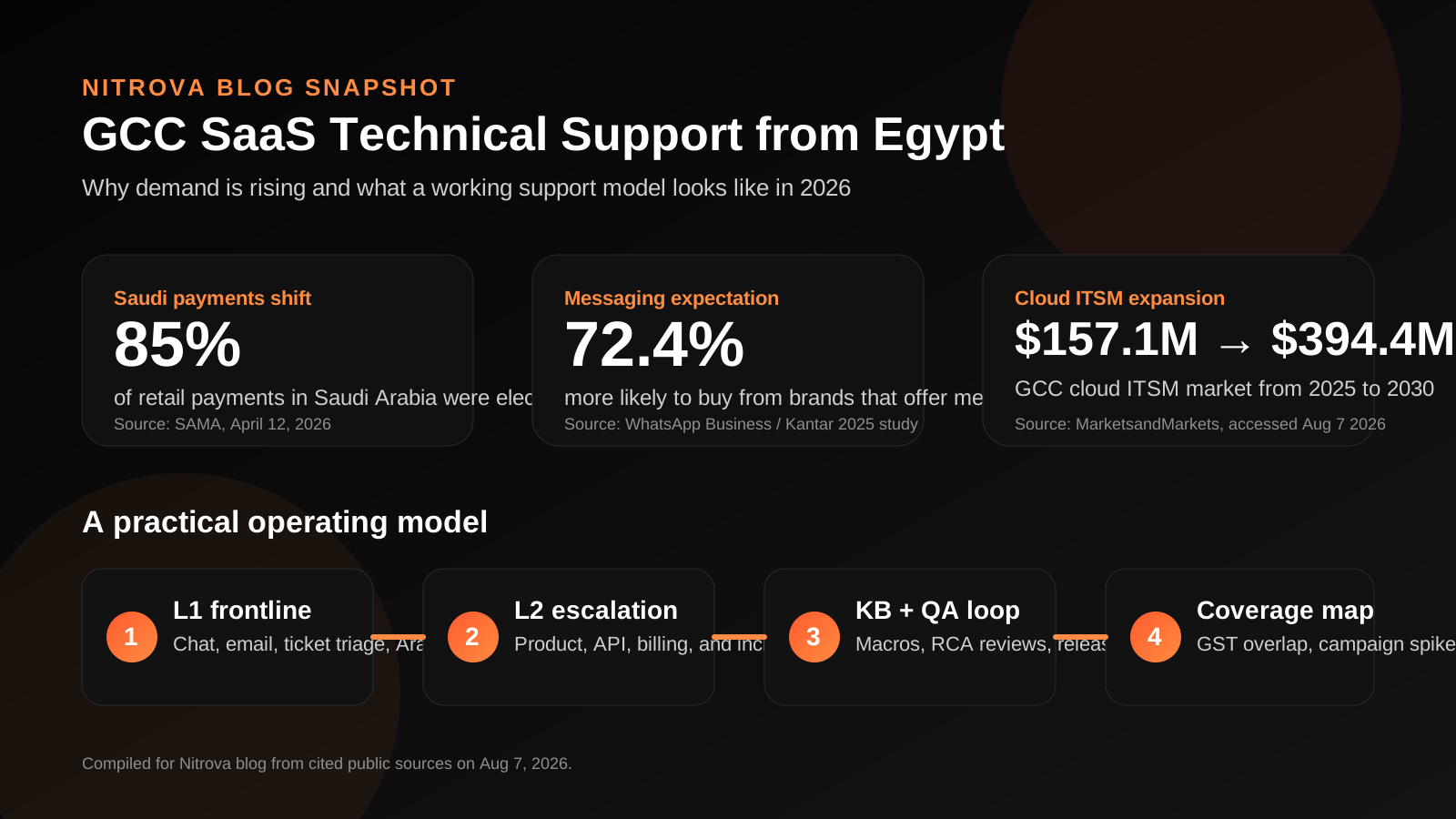
That change is happening inside a much bigger regional shift. According to SAMA, electronic payments accounted for 85% of total retail payments in Saudi Arabia in 2025, up from 79% in 2024. In SAMA's Q2 2025 economic developments report, e-commerce transactions using mada cards were reported up 65.9% year over year. When more commerce runs through digital rails, more support-critical moments move online too: checkout errors, subscription renewals, settlement questions, reconciliation mismatches, and merchant onboarding friction.
At the same time, customers are not patient about how they get help. The 2026 State of Business Messaging report from WhatsApp Business says 73.3% of consumers prefer messaging when communicating with a business, 72.4% are more likely to purchase from a brand that offers messaging, and 66.8% feel frustrated when messaging is not offered as a contact option. For Gulf operators, that lands in a very specific way. Tickets do not stay inside a neat helpdesk queue. They spill into founder inboxes, account manager chats, partner WhatsApp threads, and escalation groups that mix product, sales, and operations.
Data snapshot: Saudi retail payments were 85% electronic in 2025, mada e-commerce transactions rose 65.9% year over year in Q2 2025, and 72.4% of consumers say messaging makes them more likely to buy. Digital growth is creating more support-sensitive moments, not fewer.
Why technical support outsourcing for GCC SaaS is rising now
The demand is not only about cost. Cost matters, but the bigger issue is coverage depth. Strategy& Middle East notes that the GCC BPO market is growing more than 10% annually and could exceed $2 billion in 2025. Grand View Research estimates the wider Middle East and Africa IT services outsourcing market generated $41.2 billion in revenue in 2025, with Saudi Arabia expected to post the highest CAGR through 2033. MarketsandMarkets also estimates the GCC cloud ITSM market at $157.1 million in 2025, projected to reach $394.4 million by 2030. Put simply, Gulf companies are buying more software, running more workflows through cloud tools, and needing more structured support around them.
That is especially visible in SaaS categories where support issues carry direct commercial weight. A restaurant platform in Riyadh cannot treat printer mapping, POS sync, or branch permission errors as minor annoyances during dinner hours. A logistics dashboard in Dubai cannot allow delivery-window disputes to sit unresolved while merchants are promising same-day fulfillment. A fintech or ERP vendor serving SMEs in Saudi Arabia cannot keep asking salespeople to explain failed settlements, invoice mismatches, or user-permission bugs after every month-end push.
This is where dedicated outsourcing can become rational. Instead of treating support as an overflow task for engineers or customer success, companies build a real frontline with clear ownership. Nitrova's technical support outsourcing service is designed around that model, and it works best when the client stops thinking in generic headcount terms and starts thinking in workflow terms: what arrives, who resolves it, what gets escalated, and how fast the loop closes.
What an Egypt-based support team should actually cover
Many companies say they need technical support when what they really need is a layered support function. The front line should not behave like a script-reading call center, and engineers should not drown in every password reset, browser setting, or dashboard navigation question. A cleaner model usually looks like this:
- L1 support: first-response ticket triage, Arabic and English customer communication, account checks, issue replication, knowledge base use, status updates, and light configuration support.
- L2 support: incident ownership, deeper troubleshooting, API and integration review, billing and permissions investigation, release-related issue handling, and structured escalation to product or engineering.
- Adjacent operations: FAQ maintenance, macro updates, help-center cleanup, onboarding documentation, and recurring issue reporting back to product and leadership.
For many GCC software companies, this split is commercially healthier than asking one person to do everything. If your platform also serves merchants or end consumers, a second layer matters even more. Technical tickets often start looking like support tickets and end up exposing an operational gap. A customer says a checkout failed, but the root cause is a PSP callback issue. A merchant complains that COD orders are not syncing, but the real issue is a warehouse-status mapping error. A branch manager says users cannot print invoices, but the real issue is a role-permission rule introduced in the last release.
That is why some companies pair technical support with adjacent functions rather than isolating it. A blended model can connect customer support teams for transactional volume, virtual assistance and back-office coordination for operational follow-up, and software development capacity for faster bug escalation. The exact mix depends on where revenue friction appears first.
Where Gulf operators usually feel the pressure first
The first warning sign is rarely a formal support dashboard. It is usually a pattern of interruptions. A sales lead says demos are slipping because onboarding questions are coming back unanswered. An account manager starts forwarding screenshots from a client WhatsApp group at 10:30 p.m. Finance says more invoices are being disputed because users do not understand plan changes. Product says bug reports are too vague to act on. Founders notice that engineers are still handling tickets that should never reach them.
In the Gulf, those moments often carry a local rhythm. Support volume jumps around campaign periods, payroll weeks, billing cycles, and seasonal traffic spikes. E-commerce-enabling SaaS companies feel it when clients are chasing delivery windows, return approvals, or COD reconciliation. Hospitality and restaurant platforms feel it during evening peaks and weekend surges. B2B systems feel it near month-end close, VAT filing prep, or branch expansion waves. The mistake is to call all of this 'more tickets' and hire reactively. Good technical support design starts by mapping when the business breaks trust, not only when the queue gets longer.
How to structure technical support outsourcing without losing control
The strongest outsourcing setups do not outsource judgment. They standardize it. Start with coverage windows that match actual customer stress, not just office hours. Gulf companies often need overlap with GST business time, but they also need planned buffers for post-launch incidents, evening traffic, and weekend escalation paths. Egypt is useful here because the timezone overlap is close enough for live collaboration without forcing a fully disconnected overnight model.
Then define the handoff rules with more discipline than most teams expect. What must be solved at L1? What automatically moves to L2? What goes to engineering only after replication, logs, and customer impact are documented? What must be updated in the knowledge base after resolution? If those rules stay vague, outsourced support becomes a forwarding layer and everyone loses time.
Quality control matters just as much. Track first-response time, time-to-resolution by issue class, reopened ticket rate, backlog aging, escalation acceptance rate, and knowledge-base reuse. Also track the less glamorous but highly commercial signals: how many billing complaints were prevented from churning, how many onboarding blocks were cleared before an implementation stalled, and how many founder or account-manager escalations dropped after the first 60 days.
A useful benchmark for many GCC SaaS operators is whether support begins removing noise from product and revenue teams within the first quarter. If engineers still spend half their day translating tickets, if customer success still acts as human middleware, or if clients still default to informal WhatsApp escalation because the formal path feels slow, the model is not mature yet.
Why Egypt is a strong fit for Arabic technical support outsourcing
Egypt gives Gulf companies access to a large pool of Arabic-speaking talent that can handle technical explanation without sounding robotic. That matters more than many operators admit. A support agent who understands the product but cannot explain a permissions issue, a settlement delay, or a sync failure in clear Arabic creates a second problem while trying to solve the first. The best Egyptian support hires tend to be strong not only in language, but also in practical business context. They can understand why a merchant is panicking before a delivery cutoff, why a finance user cares about export accuracy before month-end, and why a founder wants exact wording before a client sees a status update.
There is also a scaling advantage. Instead of building locally at Gulf salary levels for every support tier, companies can create a dedicated pod in Egypt and expand it in steps: one senior L2 plus two L1 agents, then QA, then weekend coverage, then documentation ownership. That stepwise build is often easier to finance than a rushed in-market team expansion, especially for growth-stage SaaS firms that need discipline more than vanity headcount.
FAQ: technical support outsourcing for GCC SaaS companies
When should a GCC SaaS company outsource technical support?
Usually when product or customer success teams are spending too much time on repeat tickets, when Arabic support quality is inconsistent, or when after-hours issues are starting to affect retention and expansion.
Can an Egypt-based team handle both Arabic and English support?
Yes, if hiring and onboarding are done deliberately. The stronger model is to define language expectations by queue, ticket type, and customer segment rather than assuming every agent should cover every scenario equally well.
What should stay in-house?
Product roadmap decisions, final incident command, sensitive commercial decisions, and the highest-risk account escalations should remain clearly owned internally. Outsourcing works best when the client keeps control over priorities and escalation policy.
What is the first 90-day goal?
Not perfection. The first goal is a cleaner operating rhythm: faster triage, fewer founder escalations, better ticket classification, and clearer visibility into the issues that really deserve engineering time.
The regional trend is clear: more cloud adoption, more digital transactions, more messaging-led customer behavior, and more pressure on software companies to respond like real operators rather than hopeful startups. If your team is still treating technical support as something to fix later, the queue is already teaching you the opposite. The smarter move is to build the function before the next launch, next contract wave, or next payment cycle forces the lesson in public.
Sources referenced in this article: SAMA on 2025 electronic payments, SAMA Q2 2025 economic developments, WhatsApp Business messaging report, Strategy& Middle East on GCC BPO growth, Grand View Research on MEA IT outsourcing, and MarketsandMarkets on GCC cloud ITSM.