UAE payroll outsourcing changed meaning after WPS 2026
For many UAE companies, payroll used to be treated as a recurring administrative routine. It sat on a calendar, moved through a spreadsheet, and only attracted attention when something went wrong. That is no longer a safe way to think about it. After the Wage Protection System updates that took effect on June 1, 2026, payroll in the UAE became more exposed to timing risk, process errors, and compliance scrutiny. The practical question for finance leaders is no longer whether payroll matters. It is whether the current setup can survive growth without creating avoidable problems.
This is exactly where UAE payroll outsourcing has become more relevant. Not because outsourcing is fashionable, and not because every employer should rush to externalize the process. It matters because more businesses now need a payroll structure that is faster, cleaner, and easier to control across approvals, salary files, deductions, and month-end coordination.
We see this especially in firms that are expanding headcount, adding new legal entities, or dealing with a finance team that is already stretched across reporting, collections, treasury, and tax. In those environments, payroll errors do not stay inside payroll. They spill into employee trust, compliance exposure, and management distraction.
What the UAE WPS 2026 changes mean in practice
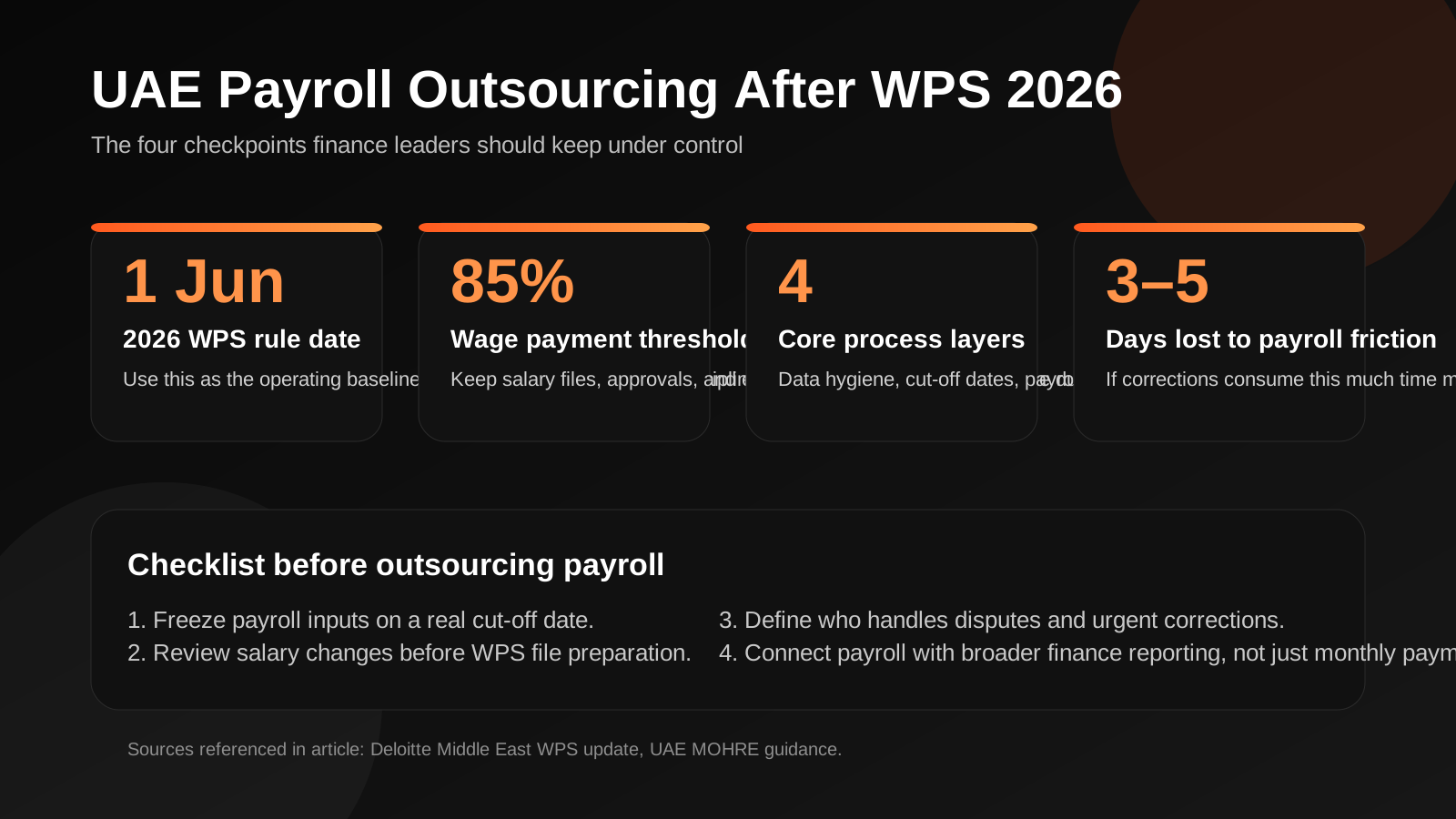
According to Deloitte's June 2026 summary of the UAE Wage Protection System update, the new framework raised the bar on timing and compliance expectations for private-sector employers. Deloitte noted that from June 1, 2026, employers must disburse current-month salaries before the beginning of the next month, and that compliance is assessed against a threshold where at least 85% of total wages must be paid by the due date. The UAE Ministry of Human Resources and Emiratisation also describes WPS as an official electronic system that facilitates salary transfer through approved financial institutions, which means the payment workflow is not just internal bookkeeping; it is part of a monitored compliance chain.
That changes the operating reality. Payroll delays, incomplete employee records, weak approval timing, and late exception handling all become more dangerous when the process is under tighter compliance expectations. A company may still think its issue is "just payroll ops," while in practice the issue is that finance, HR, and approvals are not moving in sync.
A useful way to frame the risk: once payroll timing becomes a compliance issue, every manual delay costs more than time. It can cost management attention, employee confidence, and room for operational error in the next cycle.
Why UAE payroll outsourcing is rising now
The rise in interest around UAE payroll outsourcing is not hard to understand. Employers are being pulled in two directions at once. They need stronger control, but they do not always want to build a heavier internal payroll structure. Some are trying to manage payroll across multiple branches. Others are running lean finance teams and want senior staff focused on cash flow, board reporting, VAT, or growth planning rather than payroll firefighting.
There is another factor too. The UAE is still attracting new entities, new hires, and new operating models. That means payroll complexity can increase before the company notices it in a formal org chart. A business that handled payroll comfortably at 18 employees may struggle at 60 once overtime, variable compensation, leave adjustments, and cross-functional approvals start compounding.
That is why many firms look at external finance support before the process becomes unstable. If the broader need includes not only payroll but month-end bookkeeping, reconciliations, or reporting support, it often makes sense to connect payroll decisions with a wider Accounting & Finance staffing model instead of treating payroll as a totally isolated task.
What good UAE payroll outsourcing actually looks like
A good outsourced payroll setup does not begin with software. It begins with process ownership. Someone needs to know who updates employee master data, who approves final salary changes, when variable inputs freeze, how deductions are documented, and how exceptions are escalated before payday. If those questions are unclear, outsourcing alone will not repair the system.
The better model usually includes a dedicated workflow with four layers working together. First, employee and compensation data must be clean before payroll starts. Second, cut-off dates for attendance, leave, and variable items must be realistic. Third, payroll review should happen before the WPS file stage, not after. Fourth, a documented exception path should exist for errors, disputes, or urgent corrections. When one of those layers is weak, the payroll cycle becomes fragile.
We have found that companies often underestimate the importance of the pre-payroll week. Most payroll trouble starts there, not on salary day itself. Someone submits a late change. A deduction is not backed by proper documentation. A leave adjustment arrives after the review window. By the time finance sees the issue, the payroll file is already under pressure.
Data points that finance leaders should quote internally
There are three operational numbers worth keeping in mind here. The first is the WPS compliance threshold highlighted in Deloitte's June 2026 summary: 85% of wages paid by the due date. The second is the fixed timing pressure created by the rule that current-month salaries must be paid before the next month begins. The third is not a regulatory number but a management one: if your payroll team spends three to five working days every month chasing corrections, approvals, and missing inputs, then the payroll model is already too expensive, even before any formal penalty risk is considered.
Those are the kinds of figures that help management discussions move beyond vague statements like "payroll is getting harder." A good finance lead needs to show exactly where the friction sits.
When UAE payroll outsourcing makes commercial sense
When headcount is growing faster than the finance process
This is common in service businesses, multi-branch operators, and firms expanding after a strong sales period. Headcount rises first. Process maturity catches up later. Payroll is one of the first areas where the gap becomes painful.
When payroll depends on one or two overextended people
If the same person is handling payroll, payables, reconciliations, and month-end reporting, the business is carrying concentration risk. Even a competent person becomes a bottleneck when too many deadlines converge in the same week.
When the company needs cleaner controls, not just cheaper hands
The best outsourcing decisions are usually not driven by salary arbitrage alone. They are driven by the need for cleaner turnaround, documented approvals, and a process that stays stable when the company scales.
How to evaluate a UAE payroll outsourcing partner
Ask very practical questions. How do they receive payroll inputs? What is the review timeline? Who owns exception handling? What happens when an employee dispute appears after payroll review? Can the partner support only processing, or can they also strengthen wider finance operations around reconciliations and reporting? The strength of the answer matters more than the polish of the pitch.
It also helps to ask how the partner works with internal HR and management approvals. Payroll is rarely a pure finance task. It touches attendance, leave, contracts, deductions, and employee communication. If the provider cannot explain how those handoffs are managed, then the service may remain technically correct but operationally weak.
Where companies need a broader remote finance structure, it is often smarter to connect payroll support with a larger Accounting & Finance team design rather than treating it as a one-off monthly file exercise.
Frequently asked questions about UAE payroll outsourcing
Does UAE payroll outsourcing work for small and mid-sized companies?
Yes, often very well. Smaller firms usually feel the strain earlier because payroll depends on fewer people and fewer backup layers.
Is outsourcing enough to guarantee WPS compliance?
No. The provider can strengthen the process, but the employer still needs clean employee data, timely approvals, and clear escalation rules.
Should payroll reporting sit inside finance or HR?
It usually needs both. HR owns many of the input changes, while finance needs oversight on accuracy, payment timing, and month-end consistency.
What should a monthly payroll dashboard include?
At minimum: payroll completion date, WPS submission readiness, exceptions count, unresolved salary issues, and correction turnaround time.
Closing view
The companies that handle payroll well in the UAE are rarely the ones that simply work harder at month-end. They are the ones that build a process calm enough to absorb change. After the 2026 WPS updates, that distinction matters more. If your payroll cycle feels tense every month, that is already useful information. It usually means the process is running closer to failure than leadership realizes.
For businesses reviewing UAE payroll outsourcing, the right starting point is not vendor comparison alone. It is an honest review of deadlines, approvals, exception volume, and who currently carries the process in practice. Once those pressure points are visible, the right support model becomes easier to design, whether the need is a focused payroll workflow or a broader Egypt-based finance operations team that gives management more control without adding unnecessary overhead.